Censuses are the First Step towards Disability Rights: Zooming in on the India Census
Haritha Boopalan, Suresh Kamalakannan, G.V.S. Murthy
Date: May 26th 2026
A Simple Question That Shapes the Future
Every ten years, India asks a simple question: Who lives here?
The Census of India counts every person. It records age, work, education, housing, and more. These numbers help the government make big decisions. Where should new schools be built? How much money should states get? Where are hospitals needed?
In many ways, the census shapes India’s future.
But here is a harder question: Are we counting everyone properly?
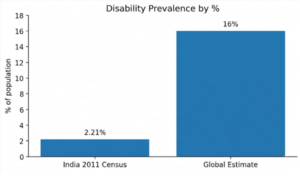
The 2011 Census of India says only 2.21% of people have disabilities. But worldwide, about 1 in 6 people (16%) have disabilities. This is a huge gap (Office of the Registrar General & Census Commissioner, India, 2011; WHO 2022).
This gap does not mean India has fewer disabled people. It means India may not be asking the right disability questions. So disabled people do not get counted. When people are not counted, their needs are not accommodated, budgeted, or included in policies.
Sources: Census of India (2011); WHO (2022)
Why Question Design Matters
The way we ask a question changes the answer we get.
In the past, many censuses asked about disability using medical labels. They asked: “Are you blind? Are you deaf? Are you mentally ill?”
But not everyone answers “yes” to these questions. Some people have trouble walking or remembering things. But they do not call themselves “disabled.” So, they do not say yes.
Today, experts recommend a better way. It is called the functional approach. Instead of asking about medical labels, we ask about daily life (Washington Group on Disability Statistics, 2020).
Better questions are:
- Do you have difficulty seeing, even with glasses?
- Do you have difficulty walking or climbing steps?
- Do you have difficulty remembering or concentrating?
This short set of questions were created by the Washington Group on Disability Statistics, which was tasked by the United Nations with this. They are now used in many countries (DDI 2025), as shown in our other blog.
Why does this work?
When countries use these functional questions, something amazing happens. They find more people with disabilities. Not because disability suddenly increased. But because people finally identify their problems in the questions.
For example, Nepal changed its disability questions.
Old question: “Are you disabled?”
New question: “Do you have difficulty seeing, even with glasses?”
With this change, they found 40% more people with vision problems. Why? These people did not suddenly become disabled. They simply identified themselves in the new question. The old question might have felt embarrassing. The new question is more relatable.
Better questions = Better data = Real change.
India does not need to start from scratch.
From Better Data to Better Policy
Governments need good disability data to answer important questions:
- Are children with disabilities going to school?
- Are adults with disabilities finding jobs?
- Are health services accessible to disabled people?
- Are social protection programs reaching disabled people?
How better data helps:
With accurate disability numbers, India can make better plans. The government can:
- Build disability services in the right places
- Create jobs for disabled people
- Make schools and hospitals accessible
- Provide the right support
Right now, India does not have this data. So, the government cannot plan adequately for disabled people.
Turning Promise into Practice
Once disability is measured properly, the data must be used to make real changes in people’s lives.
India has strong laws that protect disabled people. The Rights of Persons with Disabilities Act, 2016, calls for equality and full participation (Government of India, 2016).
India has also promised the world: “Leave no one behind” through the Sustainable Development Goals.
But promises cannot be actioned without proof. The proof comes from data.
The next census is India’s chance to close the gap.
India can do four things:
- Ask the right questions – About daily life, not medical labels
- Train census workers – Teach them to ask with care and respect
- Raise public awareness – Help families understand
- Use the data – Create real policies and services
When measurement improves, laws reflect reality better. Progress becomes easier to track. This is how strong promises turn into real change. Now is the time for India to act.
Conclusion
When a nation gathers information about its people, it decides whose lives will shape tomorrow’s plans. If the questions are narrow, many lives remain unseen. If the questions are thoughtful, the picture becomes fuller and more honest.
India stands at a moment where it can choose clarity over obfuscation.
A small change in how we ask can make a big difference in who is recognized. And recognition is the first step toward belonging.
References
DDI (2025).Disability Statistics – Questionnaire Review Database (DS-QR Database). Disability Data Initiative collective. Fordham University: New York, USA. 2025.
Government of India. The Rights of Persons with Disabilities Act, 2016. New Delhi: Ministry of Law and Justice, 2016.
Office of the Registrar General & Census Commissioner, India. Census of India 2011 Overview. New Delhi: Ministry of Home Affairs, Government of India; 2011.
Washington Group on Disability Statistics. Short set of questions on disability. Hyattsville: Washington Group; 2020.
WHO (2022). Global report on health equity for persons with disabilities. Geneva: World Health Organization.
Suggested citation for this blog:
Disability Data Initiative (DDI). (2026). Censuses are the First Step towards Disability Rights: Zooming in on the India Census. Boopalan, H., Kamalakannan, S., & Murthy, G.V.S. Accessed at https://www.disabilitydatainitiative.org/publications/DDIblog2026-02